
craftsmanship-materials
The Silversmiths of Agadez: Preserving Geometric Lineages in Contemporary High Jewellery
Beyond the shifting dunes of the Sahel, the silversmiths of Agadez translate centuries of mathematical rigor and cultural memory into contemporary adornment. Discover the quiet ateliers where raw metal is coerced into permanent architectural elegance.
10 September 2026 · 8 min
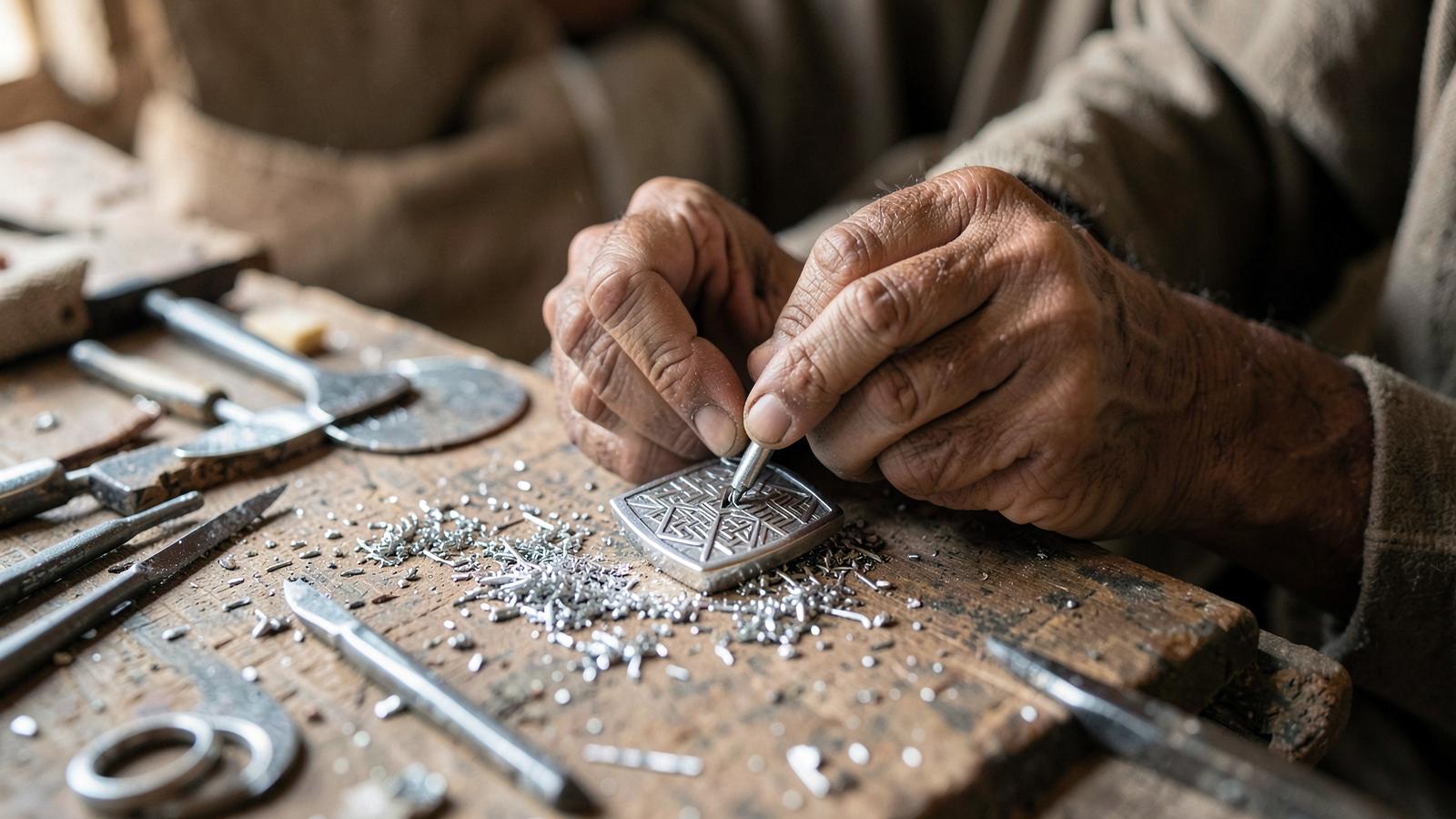
In the labyrinthine alleyways of the old city of Agadez, the ambient silence of the Sahara is rhythmically punctuated by the sharp, metallic strike of a hammer against an anvil. Here, where the ochre facades of mud-brick architecture absorb the brutal midday sun, shaded courtyards conceal a lineage of making that has endured for centuries. These quiet spaces are the domains of the *inaden*, the hereditary artisan class of the Kel Tamasheq people, whose relationship with noble metals transcends mere vocation. It is a practice of fire, dust, and exacting geometry, preserved through the generations not via written treatises, but through the visceral memory of calloused hands, the heat of the forge, and the watchful eyes of young apprentices learning the weight of a traditional hammer.
For the uninitiated observer, the desert might appear as a landscape of absence, a vast expanse defined by what it lacks. Yet, the material culture born from this environment tells a story of profound presence and deliberate structural intent. The silversmiths of Agadez do not merely manipulate metal; they coerce it into rigid, enduring architectures. Their work stands as a testament to human permanence against the backdrop of shifting dunes. In the contemporary era, as the global market increasingly interrogates the origins of its adornments, the output of these artisans is shifting from the realm of regional heritage into the exacting sphere of contemporary high jewellery. It is here, within the dialogue between ancestral technique and modern luxury, that the true value of the Sahelian silver tradition is illuminated.
The Architecture of Adornment
To understand the silver of Agadez is to understand the language of geometry. Unlike the figurative traditions found in other regions, the jewellery forged by the Kel Tamasheq is strictly non-representational, relying entirely on the mathematical harmony of the line, the circle, and the triangle. The most recognizable of these forms, commonly referred to as the cross of Agadez, is not a singular design but rather a diverse family of pendants, each indicating a specific oasis town or nomadic lineage. However, to reduce these pieces to geographical markers is to ignore the rigorous craftsmanship required to bring them into existence.
The creation of a piece begins long before the silver is polished. It starts with the crucible, nestled in a bed of glowing charcoal maintained by rhythmic bursts of air from goat-skin bellows. The raw material—historically derived from melted Maria Theresa thalers, but today often composed of pure silver ingots mixed with trace alloys for structural integrity—is brought to a liquid state. The artisan employs the lost-wax casting technique, a process demanding absolute precision. Beeswax is sculpted with specialized spatulas, forming the positive model of the final piece. This delicate wax architecture is then encased in fine clay gathered from local riverbeds and left to bake under the Sahelian sun. When subjected to the fire of the forge, the wax melts and escapes, leaving a flawless negative void ready to receive the molten silver.
Once cast and cooled, the true mastery of the *inaden* reveals itself during the engraving process. Using tools often hand-forged from salvaged steel—a discarded automotive spring transformed into a razor-sharp graver—the artisan begins to score the surface of the metal. There are no preliminary sketches, no stencils. The geometry is inscribed directly onto the silver through an internalized understanding of spatial proportion. Compasses bite into the metal to form perfect concentric circles, while straight edges guide the creation of intersecting triangles. The resulting motifs are a masterclass in architectural craftsmanship, transforming a flat plane of metal into a textured landscape of light and shadow.
The Philosophy of the Sahelian Atelier
The concept of the atelier in the European tradition often conjures images of pristine, climate-controlled environments situated above the boutiques of Place Vendôme or the historic arcades of Florence. The Sahelian atelier operates under a different set of physical parameters, yet it shares the identical devotion to uncompromising quality. In Agadez, the workshop is a communal courtyard, a space where the boundaries between domestic life and intense artisanal production blur into a singular rhythm of existence. The tools are minimal, stripped of all superfluous embellishment, engineered solely for utility and passed down from master to student over decades. The wooden handles of the hammers bear the deep, polished patina of continuous human touch.
This environment fosters a specific philosophy of making, one that resonates deeply with the shifting paradigms of the global luxury landscape. True luxury is no longer defined merely by the carat weight of a stone or the recognizable logo of a conglomerate. It is increasingly defined by provenance, by the verifiable narrative of human hands engaging with raw elements. The silversmiths of Agadez offer an unparalleled transparency in this regard. Every striation on a silver pendant, every microscopic facet carved by the graver, is a deliberate human choice. There is an inherent honesty to this mode of production that cannot be replicated by industrialized casting or computer-aided design.
Furthermore, the Sahelian atelier does not exist in a vacuum; it is part of a broader renaissance of continental material mastery. Across the contemporary African luxury landscape, we witness a profound reclamation of heritage techniques. Just as innovators in other regions are currently engineering sophisticated vegan leather alternatives, or reviving the complex, mathematical looms required for handwoven textiles, the silversmiths of Agadez contribute an irreplaceable facet to the modern lexicon of luxury materials. They prove that true sustainability and ethical production are not modern inventions, but rather the foundational operating principles of historic artisanal communities.
Cultural Provenance and the Global Vitrine
As these ancestral geometric lineages find their way into international markets, the discourse surrounding them must evolve. For decades, Saharan jewellery was often categorized under the reductive umbrella of 'ethnic crafts', a label that inadvertently stripped the artisans of their individual authorship and relegated their work to the realm of souvenirs. Today, a necessary recalibration is occurring. Institutions such as the Smithsonian National Museum of African Art have long documented the material culture of the Saharan peoples, recognizing these geometric silver works not merely as traditional artifacts, but as highly sophisticated works of structural design worthy of rigorous academic and curatorial respect.
This institutional validation is mirrored by a shift in how high jewellery brands approach collaboration. The contemporary mandate demands equitable partnership rather than extraction. When international designers engage with the ateliers of Agadez, the most successful outcomes occur when the artisan's established design vocabulary is respected and elevated, rather than compromised to fit a generalized commercial aesthetic. The integration of Agadez silver with polished ebony, or the setting of conflict-free geometric gemstones within traditional Tuareg mounts, represents a thrilling frontier for fine jewellery. It is a dialogue between disparate material worlds, held together by the universal language of meticulous craftsmanship.
Platforms and curators bear a profound responsibility in this transition. By presenting these pieces within curated marketplace environments, the narrative is shifted from one of anthropological curiosity to one of pure design excellence. The buyer is invited to understand the jewellery not just as a beautiful object, but as a culmination of history, metallurgical science, and extreme physical discipline.
The Vanguard of Preservation
The survival of the Agadez silversmithing tradition is not guaranteed by inertia. It requires the active, conscious patronage of individuals who recognize the difference between the mass-produced and the masterfully wrought. As younger generations in the Sahel face the pressures of modernization and economic migration, the viability of the *inaden* vocation depends entirely on its integration into sustainable, high-value supply chains.
When a piece of contemporary high jewellery forged in the courtyards of Agadez is worn, it carries with it the specific weight of its origins. It holds the memory of the charcoal fire, the precise mathematics of the desert compass, and the enduring resonance of the hammer upon the anvil. In an era increasingly defined by the ephemeral and the immediate, the preservation of these geometric lineages offers a rare encounter with the permanent. It is a reminder that the highest expressions of luxury are those that connect us to the profound, unbroken continuum of human artistry.
Continue reading